Are you actually ready for the investor meeting?
You only get one first meeting with most funds. Here is the honest test we run with founders before they step in the room: eight green lights, four red flags, and the one thing nobody tells you about timing.
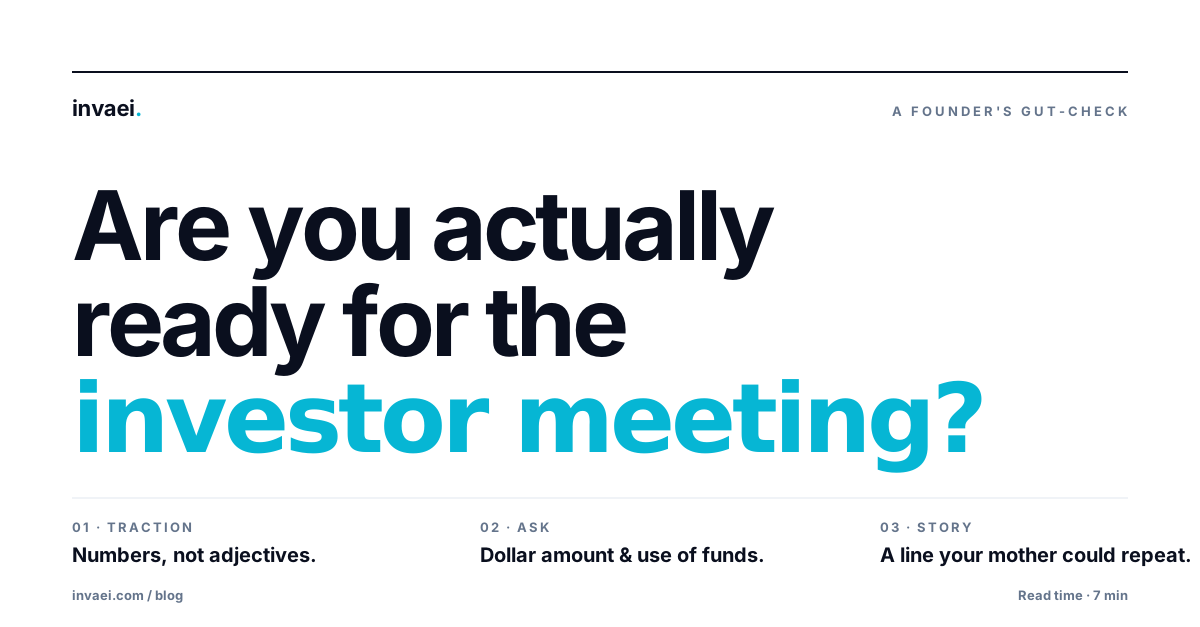
!A founder gut-check: are you actually ready for the investor meeting?
There is a thing that happens to founders two weeks before they start fundraising. It looks like confidence but it is not. It is the sudden urge to email three VCs because a friend of a friend said they were "easy to get to." No deck warm-up, no pitch rehearsal, no real traction story. Just nervous energy dressed up as momentum.
I have watched this movie too many times. The meeting happens, the fund politely passes, and now the best fit investor for your company has a stale impression of you in their head that no second email is going to fix.
So before you hit send on another intro, let us do the gut-check out loud.
The test nobody runs on themselves
When we sit with founders inside Invaei, we do not ask "is your deck ready." That is the wrong question. The better question is: if a partner walks into this meeting expecting to write you a check, do you actually know what you are walking out with?
If the honest answer is "I am hoping they will tell me," you are not ready. You are looking for validation, not capital. Partners can smell it from the first minute.
Ready founders walk in with three things locked:
That is the floor. Everything below is how you know you cleared it.
Eight signs you are ready
1. You can say the company in one sentence without breathing in the middle.
Not a paragraph. Not an analogy. One sentence. "We help [specific person] do [specific thing] faster than [current ugly workaround]." If you cannot compress it, it means you do not know what you are actually selling yet.
2. Your traction number is specific and recent.
"We have growing user interest" is not a number. "We went from 40 paid users in January to 180 in March, at $29 a month, with 78% retention at week four" is a number. Pick one metric that actually moved, and own the story behind it.
3. You know what you are asking for, to the dollar.
$1.2M pre-seed, 18 months of runway, two hires on the engineering side, one on growth. That is an ask. "Between 800K and 2M depending on valuation" is a founder hedging on Zoom.
4. You have already said no to someone.
Sounds strange, but it matters. If you have turned down at least one investor or one customer because the fit was wrong, you have shown you know who this company is for. Investors take you more seriously the second they feel you are not desperate.
5. Your co-founder dynamic is settled.
If the partner asks "how did you two meet and who owns what," you do not want to see you and your co-founder trade a look. Equity split, decision-making split, who owns product vs. GTM. Agreed on paper. Boring. Done.
6. You can answer "why now" without sounding like a pitch deck slide.
If the only thing that changed in the last two years is that ChatGPT got good, that is not a "why now." A real why-now is a regulatory shift, a cost curve flipping, a behavior change that was not possible in 2022. If you cannot describe the unlock in one breath, the investor will assume there is not one.
7. You have a short list of target investors, not a CSV.
Sending your deck to 180 funds in one week is not a fundraise. It is a cry for help. Ready founders pick 20 to 30 that actually match stage, sector, and check size, and they go deep on three to five of them first.
8. You have pitched out loud, at least five times, to a non-investor.
A friend. A mentor. The version of you from three months ago. A bathroom mirror. If the first time you are hearing your own pitch is in front of a partner, you are using them as rehearsal. They will remember.
Four signs you should wait
Not every "no" is a soft no. Sometimes the right move is to delay the meeting by four to six weeks and come in stronger.
You are raising because you are running out of cash.
This is the worst reason to raise, and investors can always tell. Desperation prices badly. If you have less than four months of runway, your play is bridge from existing believers, revenue, or cutting costs, not a new partner meeting.
You cannot explain your last major pivot in under thirty seconds.
Pivots are fine. Unclear pivots are fatal. If the story of how you got here sounds like three different companies in a trench coat, the partner leaves the meeting confused, and confused partners do not write checks.
You do not know your unit economics, even directionally.
"What is it costing you to acquire a customer, and what are they worth?" is a question every partner asks at minute fifteen. If your answer is "we have not really measured that yet," the meeting is over, they are just being nice about it for nine more minutes.
You cannot name three competitors without flinching.
"We do not really have competitors" tells a partner one of two things. Either the market is too small to matter, or you have not done your homework. Neither is a green light. Name them. Explain why you win anyway.
The thing nobody tells you about timing
Here is the secret handshake. The first investor meeting is almost never the meeting that gets you money. It is the meeting that gets you a second meeting. That is the real goal.
Which means the bar for "ready" is lower than founders think, but sharper. You do not need to have all your questions answered. You need to have a crisp enough story that the partner walks out thinking: "I want the team on my calendar again in two weeks."
Everything else is noise.
So run the eight-and-four through your own pitch tonight. If you are green on the eight, and you are not red on the four, take the meeting. If you have more than one red, spend the next three weeks fixing it. Nobody is coming to force you into a room you are not ready for.
Do the gut-check for real. Invaei has a free Pitch Check tool inside the dashboard that records a 2 to 4 minute pitch and grades you against the exact rubric partners use in first meetings. If you come out investor-ready, book the meeting. If not, we show you what to fix first.